

Table of Contents
Is barley gluten free? This question matters deeply for anyone living with celiac disease or gluten intolerance. Barley is one of the world’s oldest grains, but despite its nutrition and versatility, it contains a specific type of gluten that makes it unsafe for celiac patients. Yet recent advances in cereal science have opened the door to new possibilities, including ultra-low-gluten barley varieties that challenge conventional assumptions.
In this article, we uncover the real scientific truth behind barley and gluten—what makes barley unsafe, why it differs from wheat, and whether “gluten-free barley” can ever be considered safe. If you’ve ever wondered whether barley fits into a strict gluten-free diet, here is the clear, evidence-based answer you need.
Is Barley Gluten Free? Why Wheat Alternatives Still Fall Short?
Developing truly gluten-free wheat remains one of the greatest challenges in cereal science. Wheat has a complex hexaploid genome, composed of three subgenomes (A, B, and D), each contributing hundreds of genes that encode gliadins and glutenins—the proteins responsible for triggering celiac immune reactions. Even with advanced gene-editing tools such as CRISPR, eliminating all immunogenic peptides is extremely difficult because they are encoded redundantly across multiple chromosomes.
Although some experimental lines have successfully reduced the most toxic gluten fractions, the resulting grains often produce poor-quality doughs with weak elasticity, low loaf volume, and crumbly textures. In other words, removing gluten from wheat compromises the very proteins that make wheat bread and pasta possible. This is why, despite decades of research, gluten-free wheat remains an incomplete solution for celiac patients.
Why Barley Is a Better Candidate
Compared to wheat, barley offers a more promising scientific pathway. Barley contains four families of gluten-like proteins known as hordeins (B-, C-, D-, and γ-hordeins). Although more than 100 immunogenic peptides have been identified in barley, its diploid genome is simpler, more manageable, and easier to edit or breed for reduced toxicity.
Significant progress has been achieved through mutagenesis, classical breeding, and modern CRISPR techniques to suppress or eliminate hordein production. The most advanced example is the Australian variety Kebari®, which contains less than 5 ppm of gluten, far below the international gluten-free standard of 20 ppm. While not yet approved for celiac consumption, Kebari® represents a major scientific milestone and highlights why barley is considered one of the most realistic candidates for developing safe, low-gluten grains.
Barley vs Other Grains: Nutritional Benefits
Compared to rice and corn, barley offers better nutrition, especially for people on gluten-free diets:
| Component | Wheat (refined) | Barley (whole grain) | Rice (white) | Cornmeal |
|---|---|---|---|---|
| Fiber (g/100g) | 2.7 | 17.3 | 0.4 | 7.3 |
| Beta-glucans | Negligible | 3–7 g | 0 | 0 |
| Protein (g/100g) | 10–13 | 10–12 | 7 | 9 |
| Glycemic Index | 70–90 | 25–30 | 70–90 | 68–70 |
Discover the full nutritional benefits of barley beyond gluten and See all health benefits of barley
Is Barley Safe for Celiac Patients?
Traditional barley is not safe for celiac patients. But ultra-low gluten (ULG) lines like Kebari® show no activation of T-cells in lab tests, and may be used safely in controlled food products like beer, flakes, or flatbreads—if certified gluten-free.
Barley, Wheat, and Allergy Risks
Some allergic reactions to grains, such as eosinophilic esophagitis (EoE), are triggered by wheat and, in rare cases, barley. According to Kliewer et al. (2015), wheat is a well-known cause of EoE through IgE reactions. Barley is less commonly implicated, and most issues stem from cross-contamination or multiple sensitivities.
This suggests that while traditional barley should be avoided, barley gluten free alternatives may eventually be tolerated under medical guidance.
What Do the Regulations Say?
- Codex Alimentarius: Gluten-free = <20 ppm gluten
- FDA (USA): Accepts <20 ppm standard, but does not yet officially list barley-based products as gluten-free
- EFSA (Europe): Calls for more clinical evidence before labeling
Advice for Celiac Patients and Healthcare Providers
If you have celiac disease or gluten sensitivity:
- Only consume barley products made from certified ultra-low gluten varieties like Kebari®
- Avoid ingredients like “malt” or “natural flavor” unless clearly labeled gluten-free
- Consult your doctor or dietitian before trying new barley-based products
- Track your symptoms and ask for antibody testing if reintroducing barley
How Scientists Are Creating Safer Barley
To produce barley that is safe for people with celiac disease, researchers are using several advanced techniques:

- Mutagenesis: In this method, barley seeds are exposed to chemicals or radiation to create random mutations. Scientists then select the plants that naturally lose the ability to produce harmful hordeins. This was one of the early steps in developing ultra-low gluten barley.
- Selective breeding: This classical approach involves crossing barley plants that already show reduced hordein expression, concentrating the low-gluten trait over several generations.
- CRISPR/Cas9 genome editing: This modern and precise method allows researchers to switch off or edit the exact genes responsible for immunogenic proteins, without introducing foreign DNA. It is considered the most promising approach for future gluten-free cereal innovation.
These combined efforts have led to new barley lines that maintain their nutritional value and functional properties, while minimizing the risk for people with gluten intolerance or celiac disease.
What Do Lab Tests Say About Kebari®?
Kebari® barley has undergone extensive laboratory analysis to ensure its safety. In-vitro tests using T-cells from celiac patients have shown that products made from Kebari®—such as flatbreads, breakfast flakes, and beer—do not activate immune responses. Gluten content consistently falls below 5 ppm, which is far under the Codex standard of 20 ppm. These findings are supported by recent research by Hanak et al. (2024), who demonstrated the effectiveness of advanced molecular and breeding techniques in creating ultra-low gluten barley lines suitable for gluten-free diets.
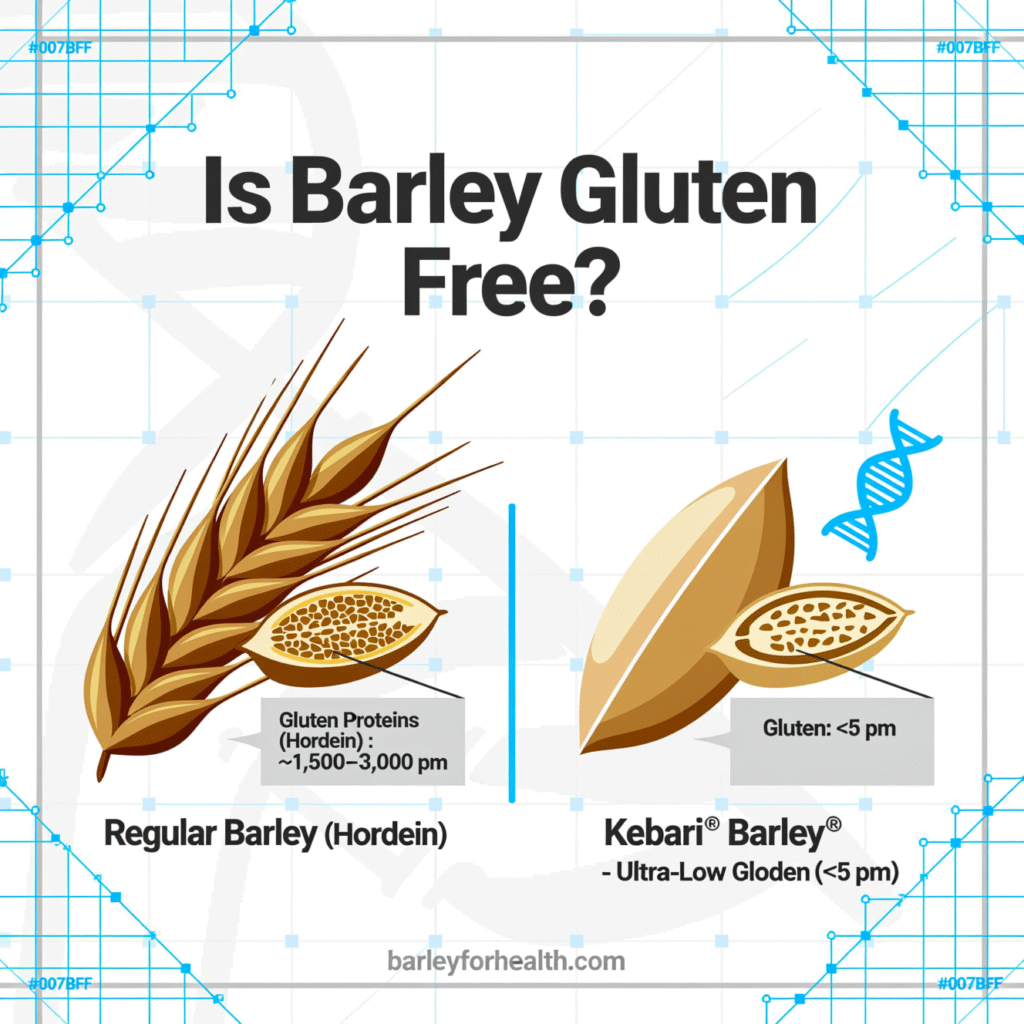
Importantly, Kebari® is not a genetically modified organism (GMO); it was developed through conventional breeding and selection techniques over a decade. This makes it more acceptable for regulatory approval and consumer use in many countries.
Real Food Products Using Barley Gluten Free Alternatives
Several food and beverage companies are now experimenting with ULG barley to bring new gluten-free options to market:
- Gluten-free beer made from Kebari® is already available in Australia and parts of Europe, offering a better taste profile than rice- or sorghum-based beers.
- Breakfast cereals such as barley flakes are being formulated for high-fiber, heart-healthy options suitable for gluten-free diets.
- Flatbreads and snacks made from low-gluten barley flour are under development, aiming to offer texture and flavor closer to traditional wheat-based products.
As research progresses and more consumers demand nutritious gluten-free choices, the use of barley gluten free alternatives in food innovation is expected to grow rapidly.
Explore the history of barley and its role in ancient diets
A New Era for Gluten-Free Grains?
Barley, long excluded from gluten-free diets, may finally be on the verge of a scientific comeback. Thanks to major advances in cereal genomics, improved food testing, and the development of ultra-low-gluten varieties such as Kebari®, researchers are beginning to reshape what we once believed about barley and gluten safety.
While traditional barley remains unsafe for people with celiac disease, new breeding strategies—combining mutagenesis, targeted gene editing, and precise immunogenic peptide screening—have demonstrated that significantly reducing hordeins is possible without sacrificing grain quality. If ongoing studies confirm long-term safety and regulatory bodies approve these varieties, barley-based gluten-free alternatives could bring much-needed nutrition, flavor, and diversity to a gluten-free market still dominated by rice and tapioca starches.
We are not there yet. Clinical validation, strict certification standards, and global regulatory consensus are still required. But for the first time, science is offering a realistic pathway toward safer, more nutritious gluten-free barley products—a development that could redefine gluten-free diets for millions of people.
What People Ask Too
1. Is barley safe for celiac disease?
No. Traditional barley contains hordein, a form of gluten that triggers an autoimmune reaction in people with celiac disease. Even small traces can cause intestinal damage.
2. Does barley contain more or less gluten than wheat?
Barley contains less gluten total than wheat, but its gluten proteins (hordeins) are still immunogenic for celiac patients. This means barley is unsafe, even if the quantity is lower.
3. Are there truly gluten-free barley varieties?
Yes—scientists have developed ultra-low-gluten barley varieties such as Kebari®, containing less than 5 ppm of gluten. However, they are not yet approved as safe for people with celiac disease.

