

Table of Contents
Introduction
Whole wheat flour is often presented as a healthier alternative to refined white flour, but the real problem goes deeper than choosing brown bread instead of white bread. The real question is what happens inside the body when refined flour products are eaten every day for years. White flour may feel soft, light, and easy to digest, but its rapidly digestible starch can repeatedly stimulate blood sugar, insulin, hunger, and metabolic stress. Over time, this repeated pattern may contribute to insulin resistance, low-grade inflammation, fatty liver, weight gain, and other metabolic disorders in susceptible people.
This does not mean that one slice of white bread is dangerous. It does not mean that white flour is a poison. The problem is repetition. When refined flour becomes the base of breakfast, lunch, snacks, and dinner, the body may be exposed to a constant cycle of fast digestion, glucose rise, insulin demand, hunger, and fatigue.
This is what we can call the white flour trap.
White flour gives comfort. It gives softness. It gives quick energy. But when it dominates the diet, it may slowly weaken the body’s metabolic balance.
What Is the White Flour Trap?
The white flour trap begins with a simple misunderstanding.
Many people judge food only by how it feels in the stomach. If a food is soft, smooth, and easy to chew, they assume it is good for digestion and harmless for the body.
White bread, pizza dough, cakes, biscuits, pancakes, pastries, and refined pasta often feel easy to eat. They do not contain much coarse fiber. They are soft and pleasant. But after digestion, refined flour behaves mainly as a source of rapidly available starch.
This starch is broken down into glucose. Glucose enters the blood. The pancreas responds by releasing insulin. Insulin helps glucose enter the cells.
This is normal.
The problem appears when this process happens too often, too quickly, and with too little fiber to slow it down.

This cycle can become invisible because it happens slowly. A person may not feel sick immediately. But over months and years, the body may become less sensitive to insulin.
White Flour Is Easy to Eat, but Not Always Easy for Metabolism
White flour is made by removing much of the bran and germ from wheat grain. What remains is mainly the starchy endosperm.
This refining process gives white flour its smooth texture and pale color. It also improves shelf life and makes dough softer. But it removes much of the natural fiber, minerals, vitamins, and protective compounds found in the whole grain.
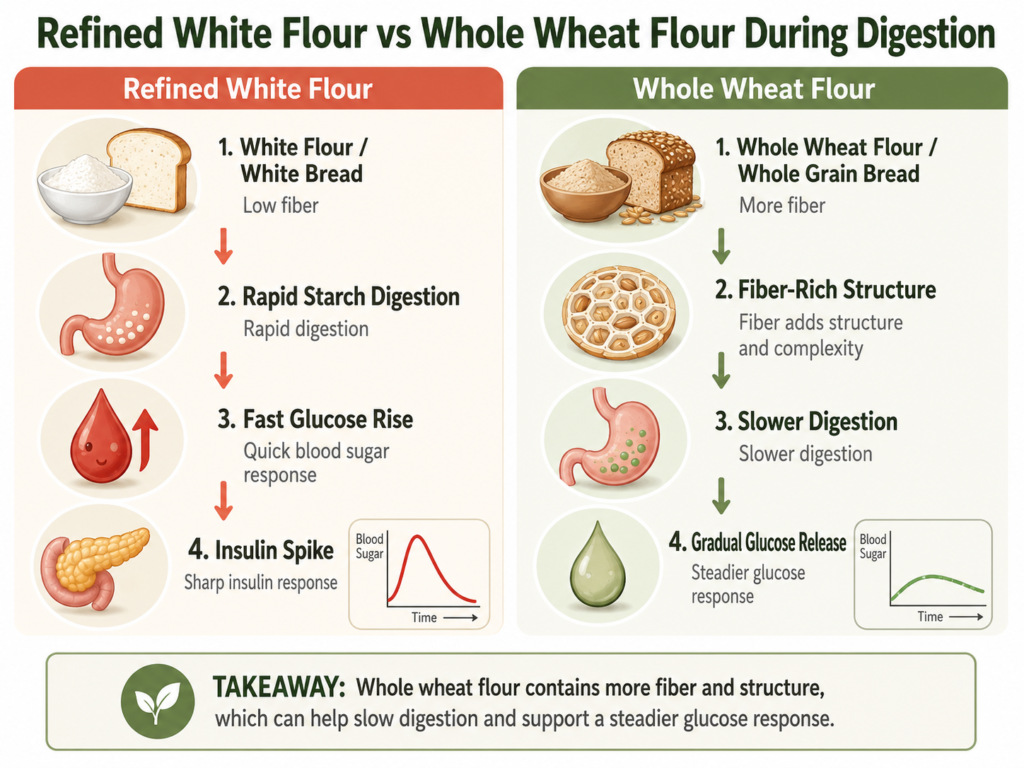
Whole wheat flour is different. It contains the bran, germ, and endosperm. This means it provides more fiber, more micronutrients, and a more complex food structure.
This food structure matters. The body does not react only to calories. It reacts to the speed of digestion, the rise in blood glucose, the amount of insulin needed, the effect on gut bacteria, and the level of satiety after eating.
The World Health Organization recommends that carbohydrates should come mainly from whole grains, vegetables, fruits, and pulses as part of a healthy diet that helps reduce the risk of noncommunicable diseases.
So the question is not simply:
Is white flour easy to digest?
The better question is:
What metabolic signal does white flour send to the body when it is eaten every day?
Does White Flour Stick to the Stomach or Intestines?
Some people say that white flour “sticks” to the stomach or intestines like glue. Scientifically, this is not accurate.
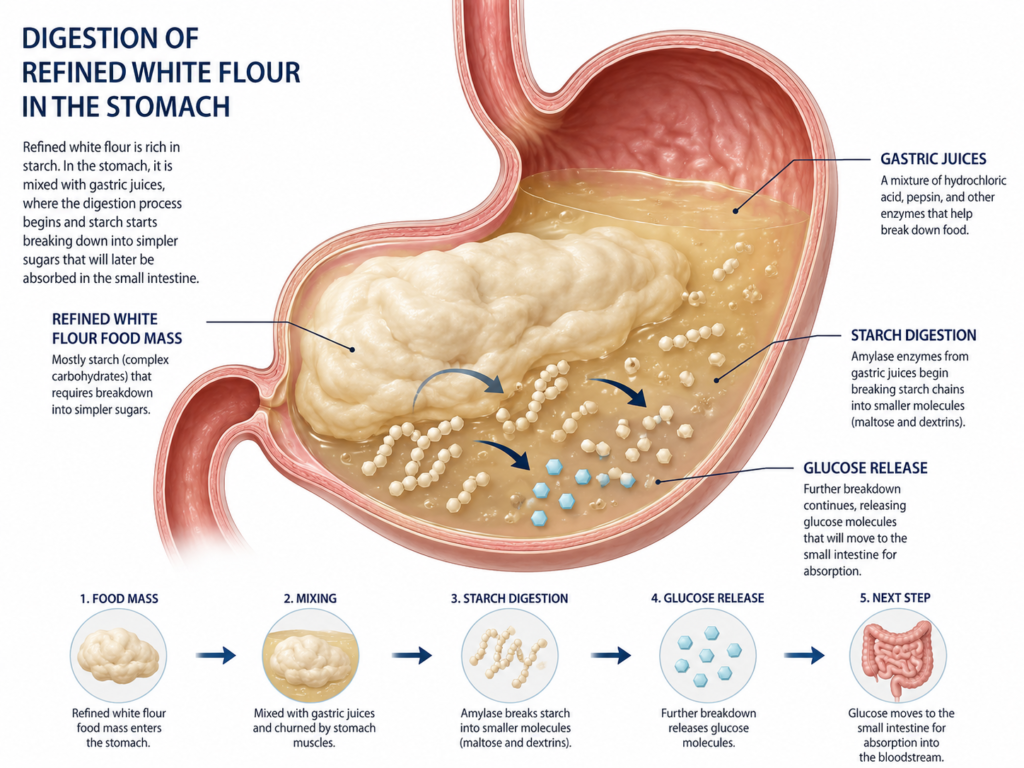
White flour does not remain permanently stuck to the digestive wall. The stomach and intestines are protected by mucus, digestive fluids, and constant muscular movements that push food forward.
But there is a more accurate way to explain the sensation.
Products made from white flour can form a soft, dense, sticky, or elastic food mass, especially when combined with water, fat, sugar, and gluten. This can happen with fresh white bread, pizza, pancakes, pastries, biscuits, or heavy dough-based foods.
These foods may require more time to be mixed with digestive juices and emptied from the stomach. In some people, this can create a sensation of heaviness, reflux, bloating, or slow digestion. Your source document explains this nuance clearly: white flour does not literally stick to the digestive wall, but refined flour products can form a dense food mass that may be felt as slow or heavy digestion in some situations.
White flour does not glue itself to the intestine.
But refined flour products can form a soft, dense paste that may slow gastric emptying and make digestion feel heavy. As this paste is gradually broken down, starch is converted into glucose, which may prolong the body’s need for insulin. Repeated often, this can add to metabolic stress.
The Insulin Problem: The Pancreas Is Not Always the First Culprit
Insulin is often misunderstood.
Many people think that diabetes begins only when the pancreas fails. But in the early stages of insulin resistance, the pancreas may still produce insulin. In fact, it may produce more insulin than usual.
The real issue is that the body’s cells stop responding properly to insulin.
The NIDDK defines insulin resistance as a condition in which the body does not respond to insulin the way it should. This can lead to increased blood glucose and prediabetes.
The American Diabetes Association also explains that when insulin resistance increases, the body needs more insulin to achieve the same effect on blood glucose regulation.
This means that a person can have normal blood sugar for some time while already producing too much insulin. This hidden phase can last for years.
Refined flour can contribute to this process when it is consumed frequently because it can increase the demand for insulin after meals.
The pattern may look like this:
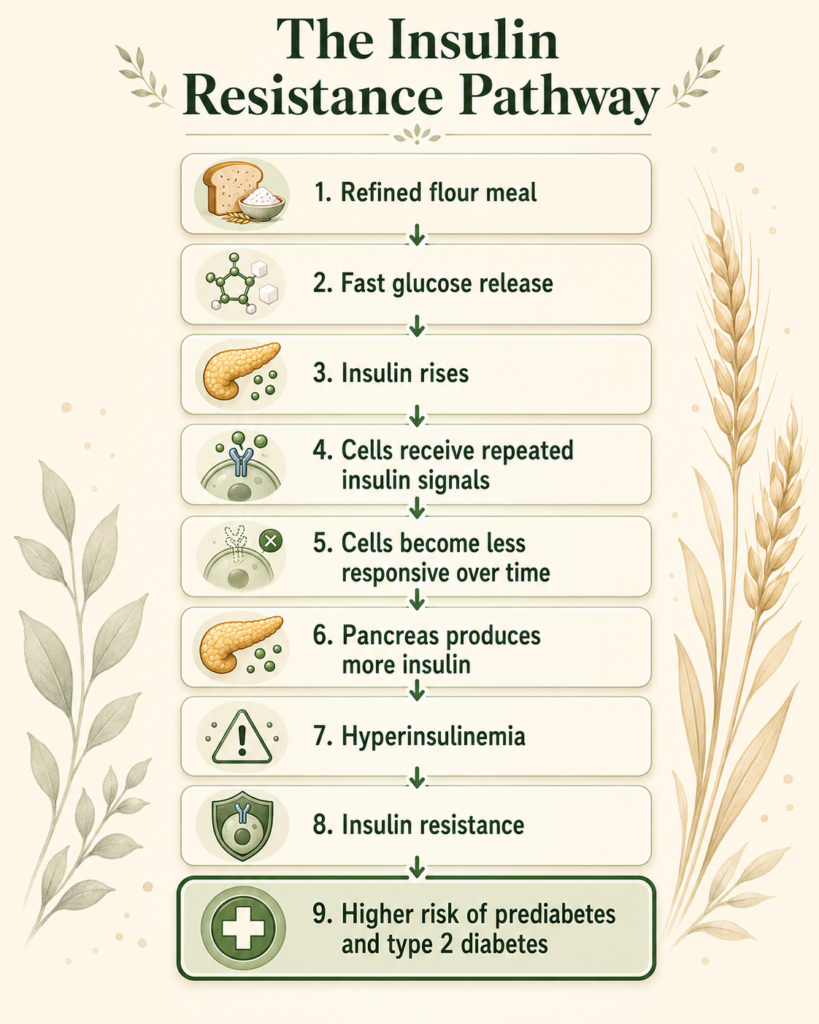
This is why the problem is not only sugar. Refined starch can also become a metabolic burden when it is eaten too often.
The Liver: The Forgotten Organ in the White Flour Trap
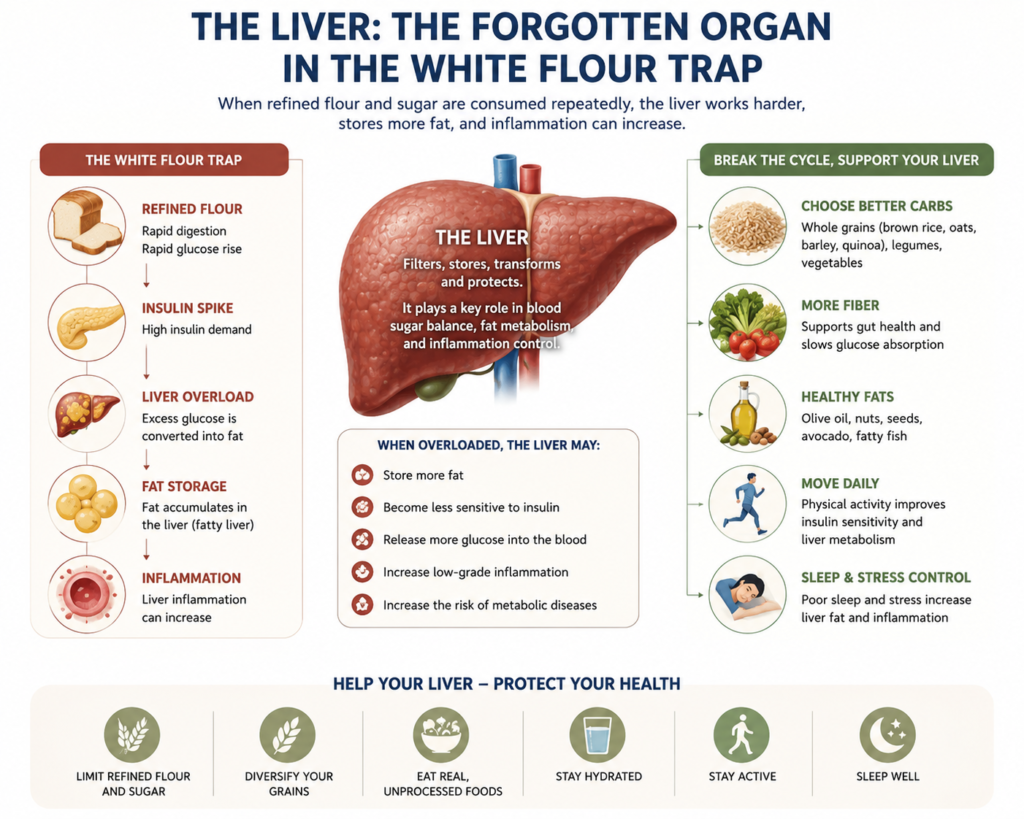
When people talk about diabetes, they usually talk about the pancreas. But the liver is also central.
The liver stores and releases glucose. When you are fasting, the liver releases glucose to keep blood sugar stable. This is normal and necessary.
After a meal, insulin should tell the liver:
“There is enough glucose in the blood. Stop releasing more.”
But in insulin resistance, the liver may not respond properly. It can continue producing or releasing glucose even when the blood already has enough.
This can contribute to high fasting blood sugar, especially in the morning.
A diet rich in refined flour, sugar, excess calories, and ultra-processed foods may also contribute to fat accumulation in the liver, especially when combined with low physical activity. A fatty and inflamed liver may become less sensitive to insulin.
So the white flour trap is not only about the stomach. It involves the intestine, pancreas, liver, muscles, fat tissue, hormones, and inflammation.
The Muscles: Your Natural Glucose Sink
Muscles are one of the best places for glucose to go after a meal.
When muscles are active, they use glucose for energy. They can also store glucose as glycogen. This helps reduce blood sugar and reduces the amount of insulin needed.
But when muscles are inactive, glucose stays longer in the blood. The pancreas must release more insulin to manage it.
This is why walking after meals can be powerful. It helps muscles use glucose directly.
A simple walk after eating can reduce the pressure on insulin.

In other words:
Active muscles help protect the pancreas.
Inactive muscles make glucose control harder.
This is important because the white flour trap becomes worse when refined flour intake is combined with a sedentary lifestyle.
The Gut: More Than a Digestive Tube
The intestine is not just a tube that digests food. It is a major communication center between diet and the rest of the body.
It helps:
- digest food;
- absorb nutrients;
- regulate the passage of molecules into the blood;
- communicate with the liver;
- influence the brain;
- regulate appetite hormones;
- interact with the immune system;
- host the gut microbiota;
- produce useful metabolites such as short-chain fatty acids.
When digestion works well, the intestine supports the whole body.
But when the diet is repeatedly poorly adapted — too refined, too low in fiber, too rich in sugar and fat, or poorly tolerated — the intestine may become a source of discomfort and imbalance.
This can include:
- bloating;
- reflux;
- gas;
- slow digestion;
- constipation or diarrhea;
- altered microbiota;
- low-grade irritation;
- poor absorption in some cases;
- immune activation in susceptible people.
Your document summarizes this idea well: repeated digestive disturbance should not always be seen as a simple local discomfort, because the intestine can become an amplifier of metabolic, hormonal, immune, inflammatory, and nutritional imbalance.
This is the key idea:
A single bad meal is not the main problem.
The daily repetition of digestive and metabolic stress is the real issue.
Low-Grade Inflammation: The Silent Background
Low-grade inflammation is not like an infection with fever. It is a quiet, chronic inflammatory state that can exist in the background.
It may be linked with:
- insulin resistance;
- abdominal fat;
- fatty liver;
- poor sleep;
- chronic stress;
- low physical activity;
- poor gut health;
- diets high in refined carbohydrates and ultra-processed foods.
White flour alone should not be blamed for all inflammation. But a diet dominated by refined flour products and low in fiber may contribute to a metabolic environment that favors inflammation.
Why?
Because such a diet may:
- increase blood glucose fluctuations;
- increase insulin demand;
- reduce fiber intake;
- weaken microbiota diversity;
- reduce satiety;
- promote overeating;
- contribute to fat accumulation;
- increase metabolic stress.
Over time, this may create a terrain that supports chronic diseases.
The WHO highlights that healthy diets based on whole grains, vegetables, fruits, legumes, and nuts help protect against noncommunicable diseases.
Why Whole Wheat Flour Is a Better Direction
Whole wheat flour is not perfect for everyone, but it is generally a better direction than refined white flour.
It contains more fiber.
It contains more minerals.
It contains more natural grain compounds.
It slows digestion compared with refined flour.
It supports satiety better.
It may reduce the speed of glucose absorption.
This does not mean that everyone should immediately eat large amounts of whole wheat bread. Some people with sensitive digestion may feel bloating or heaviness when they increase fiber too quickly.
The solution is not to reject whole grains. The solution is to introduce them intelligently.
For example:
Start with 25% whole wheat flour and 75% white flour.
Then try 50% whole wheat flour and 50% white flour.
Use long fermentation.
Try sourdough.
Hydrate the dough well.
Avoid combining flour with too much sugar and fat.
Observe personal tolerance.
The goal is not to shock the digestive system. The goal is to rebuild a better relationship between food, digestion, and metabolism.
Barley Flour: A Powerful Example for Barley for Health
At Barley for Health, this subject is especially important because wheat is not the only cereal that can influence digestion and metabolism.
Barley flour is a very interesting example.
Unlike refined white wheat flour, barley flour naturally contains beta-glucans, a type of soluble fiber. Beta-glucans can form a viscous gel-like network during digestion. This can slow the movement of food, delay glucose absorption, and support a more gradual blood sugar response.
This is one reason barley is often studied in relation to cholesterol, satiety, glycemic response, and metabolic health.
The FDA has authorized health claims for soluble fiber from certain foods, including barley beta-glucan, in relation to reducing the risk of coronary heart disease when consumed as part of a diet low in saturated fat and cholesterol.
This does not mean barley flour is a medicine. It means barley has a nutritional structure that deserves serious attention.
White flour is mostly fast starch.
Whole wheat flour brings more fiber and nutrients.
Barley flour brings soluble fiber, especially beta-glucans, with a stronger functional potential.
To understand why barley may be especially interesting for metabolic health, read our guide on barley flour and beta-glucans.
The Real Problem Is Not One Food, but the Repeated Pattern
The real problem is not one slice of white bread or one plate of pasta.
The problem is the daily repetition of the same metabolic pattern:
white bread at breakfast, refined pasta at lunch, biscuits in the afternoon, pizza or white bread at dinner — often combined with sweet drinks, low fiber intake, little movement, poor sleep, and stress.
Over time, this lifestyle can create a silent loop:
Refined flour
↓
Rapid glucose rise
↓
Higher insulin demand
↓
Energy drop and hunger return
↓
More refined foods
↓
Low fiber intake
↓
Gut microbiota imbalance
↓
Low-grade inflammation
↓
Insulin resistance
↓
Higher risk of metabolic disease
This is the white flour trap: a repeated cycle of fast starch, insulin pressure, cravings, poor gut support, and long-term metabolic stress. it is comfortable at the beginning, but costly over time.
How to Escape the White Flour Trap
Escaping the white flour trap does not mean eliminating all carbohydrates. The goal is to move away from a diet dominated by refined white flour and build a more diverse, fiber-rich, and metabolically balanced way of eating.
A practical first step is to diversify your grain sources. Instead of relying only on white bread, refined pasta, biscuits, and pizza dough, the diet can gradually include better-quality carbohydrates such as:
This diversity matters because each grain has a different structure, fiber profile, mineral content, and effect on digestion. Brown rice, for example, keeps more of the grain structure than white rice. Barley provides beta-glucans, a soluble fiber that may help slow digestion and support a steadier glucose response. Oats also contain beta-glucans, while whole wheat flour provides more fiber and nutrients than refined white flour.
The goal is not to replace white flour with one single “perfect” food. The goal is to reduce repetition, improve food quality, and give the gut and metabolism a wider range of nutrients and fibers.
Final Takeaway
Escaping the white flour trap does not mean eliminating all carbohydrates. The goal is to move away from a diet dominated by refined white flour and build a more diverse, fiber-rich, and metabolically balanced way of eating.
A practical first step is to diversify your grain sources. Instead of relying only on white bread, refined pasta, biscuits, and pizza dough, the diet can gradually include better-quality carbohydrates such as whole wheat flour, brown rice, oats, barley, rye, millet, sorghum, buckwheat, quinoa, and well-prepared legumes.
This diversity matters because each grain has a different structure, fiber profile, mineral content, and effect on digestion. Brown rice, for example, keeps more of the grain structure than white rice. Barley provides beta-glucans, a soluble fiber that may help slow digestion and support a steadier glucose response. Oats also contain beta-glucans, while whole wheat flour provides more fiber and nutrients than refined white flour.
The goal is not to replace white flour with one single “perfect” food. The goal is to reduce repetition, improve food quality, and give the gut and metabolism a wider range of nutrients and fibers. In this sense, whole wheat flour can be an important first step, but it becomes even more powerful when it is part of a diversified whole-grain diet.
References
The World Health Organization recommends that carbohydrates come mainly from whole grains, vegetables, fruits, and pulses, and emphasizes healthy diets for reducing the risk of noncommunicable diseases.
The NIDDK explains that insulin resistance occurs when the body does not respond to insulin properly, which can lead to increased blood glucose and prediabetes.
The American Diabetes Association explains that insulin resistance means the body needs more insulin to achieve the same effect on blood glucose regulation.
The CDC describes how insulin resistance can progress toward prediabetes and type 2 diabetes when the pancreas can no longer keep up with the body’s insulin needs.
The FDA recognizes barley beta-glucan soluble fiber as an eligible source for authorized health claims related to reduced risk of coronary heart disease, when consumed as part of a diet low in saturated fat and cholesterol.

