

Table of Contents
A World Ready for Caffeine-Free Energy
Caffeine free drinks are gaining attention as more people seek natural ways to boost energy and focus without the side effects of caffeine. Coffee may fuel our mornings, but it also fuels restlessness, anxiety, and sleepless nights. For many, that daily cup has become more of a necessity than a pleasure — a ritual that keeps us awake yet often leaves us depleted. Caffeine acts as a powerful stimulant by blocking adenosine receptors in the brain, delaying fatigue and triggering the release of adrenaline. The result? A short burst of alertness followed by a crash that can disrupt mood, focus, and even hormonal balance.
As lifestyles become more stressful and sleep-deprived, the world’s dependence on caffeine has quietly reached record levels. Studies reveal that more than 80% of adults consume caffeine every single day, often through multiple sources — coffee, tea, soft drinks, chocolate, or energy beverages. While moderate intake can be safe, exceeding 300 mg per day—the equivalent of about three cups of coffee—has been linked to insomnia, anxiety, increased heart rate, and pregnancy complications (Cornelis, Nutrients 2019).
These findings have sparked a quiet revolution: a global shift toward caffeine-free drinks — beverages that offer energy, comfort, and focus without overstimulating the nervous system. From herbal teas to grain-based brews, consumers are rediscovering how nature can energize gently, without dependency or withdrawal.
Among these natural alternatives, barley coffee shines as one of the most promising. Entirely caffeine-free, this roasted barley drink delivers the deep, satisfying flavor of coffee — but with none of its downsides. It not only supports calm alertness but also brings an array of nutritional and functional benefits, from improved digestion to balanced metabolism.
In a world where overstimulation has become the norm, barley coffee offers a rare balance — the warmth of coffee, the peace of tea, and the nourishment of a whole grain.
Barley Coffee: The Ancient and Naturally Caffeine-Free Brew
Barley coffee, known as caffè d’orzo in Italy or mugicha in Japan, is made by roasting and grinding barley grains to create a dark, aromatic beverage that looks and tastes remarkably similar to coffee — but contains absolutely no caffeine.
Once a humble drink in traditional farming communities across Europe and Asia, barley coffee is now making a comeback as a healthy, sustainable alternative to conventional coffee. Its preparation is a craft in itself: the grains are carefully cleaned and roasted at high temperatures (around 200 °C) until they develop a deep brown color and a complex aroma. When brewed, the result is a cup with nutty, cocoa-like, and toasty notes, offering the comforting warmth of coffee with none of its side effects.
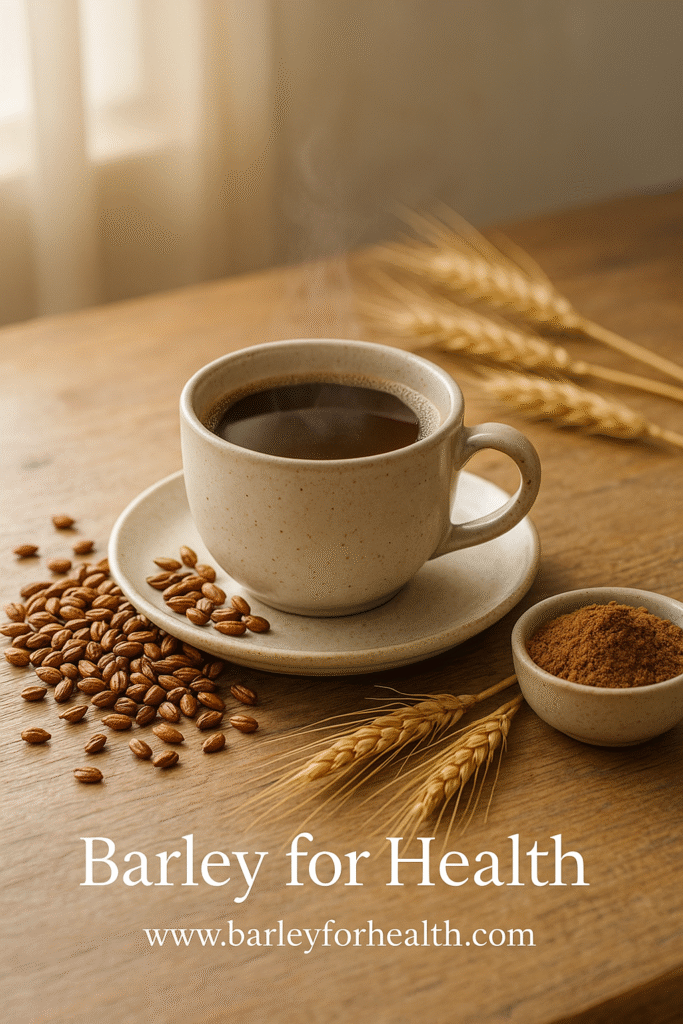
Science backs up what tradition has long known. A recent study by Ali et al. (2023) showed that barley roasted for 55 minutes at 200 °C produced a beverage whose flavor, aroma, and texture closely rivaled Brazilian coffee, yet with 0% caffeine detected. Even more striking, sensory panelists rated roasted barley coffee as nearly equal in enjoyment to traditional coffee — appreciating its smoothness, balance, and gentle character.
But barley coffee is more than a substitute — it’s a functional food in a cup. Rich in complex carbohydrates, soluble fiber, and natural antioxidants, it supports steady energy release and promotes digestive comfort.
In comparative analyses, Jamil et al. (2022) found that barley-based beverages exhibit significant antioxidant activity while being non-toxic to human cells, unlike strong caffeine extracts that can stress the nervous system and alter cellular metabolism.
That makes barley coffee not only safe but beneficial for daily well-being — a beverage that nourishes while it soothes, reconnecting modern health trends with ancient wisdom.
In short, drinking barley coffee isn’t just about avoiding caffeine; it’s about embracing a restorative ritual — one that energizes gently, supports gut health, and celebrates the wholesome power of the grain itself.
Natural Energy Without the Jitters
Unlike commercial energy drinks overloaded with caffeine, sugar, and synthetic additives, barley coffee offers calm, steady energy that lasts. Its power doesn’t come from artificial stimulation but from the grain’s own natural nutrition. Rich in complex carbohydrates and soluble fiber, barley helps the body release glucose slowly into the bloodstream — promoting balanced energy levels, mental focus, and satiety without spikes or crashes.
A Malaysian study published in the International Food Research Journal (2022) compared beverages made from Arabica coffee, date seeds, and barley powder. The findings were striking: both the barley and date seed drinks contained no detectable caffeine, less fat, and more carbohydrates and natural antioxidants than regular coffee. Even more importantly, these caffeine-free beverages showed no signs of toxicity on human cells, confirming their safety for daily consumption.
In essence, barley coffee fuels your body the natural way through nourishment, not stimulation. It restores energy gently, supports digestion, and keeps your mind alert without the nervous tension or fatigue rebound so common with caffeine.
Health Benefits Backed by Science
1. Supports Heart and Metabolic Health
Barley is naturally rich in β-glucans, a soluble fiber proven to lower cholesterol and regulate blood sugar. Researchers like Zeng et al. (2020) highlighted barley’s role in reducing cardiovascular risk and improving glycemic control.
2. Promotes Digestive Comfort
Unlike acidic coffee, barley coffee is low in acidity, easy on the stomach, and suitable for people with reflux or digestive sensitivity. Its fiber supports beneficial gut bacteria — a bonus for long-term metabolic balance.
3. Rich in Antioxidants
Although roasted barley contains fewer phenols than traditional coffee, it still exhibits strong DPPH radical-scavenging activity (Ali et al., 2023), protecting cells from oxidative stress and inflammation.
In Japan, studies on roasted barley tea (mugicha) even revealed anti-inflammatory and anti-obesity effects, reinforcing barley’s functional food potential.
A Sustainable and Local Alternative
The caffeine-free movement isn’t just about personal health — it’s also an environmental awakening. Every cup of traditional coffee comes with a hidden ecological cost: the crop demands vast amounts of water, fertile land, and chemical inputs, and is grown mainly in tropical regions already vulnerable to deforestation and climate stress. Processing and long-distance transportation further increase its carbon footprint.
Barley, by contrast, is a climate-resilient and low-input grain. It thrives in temperate and semi-arid zones, requires less irrigation, and adapts well to poor soils — making it a perfect candidate for sustainable farming systems. Its short growing cycle and local availability in many countries, including North Africa and the Mediterranean, mean that barley-based beverages can offer a lower-impact, locally sourced alternative to imported coffee.
The potential benefits go far beyond the environment. Supporting local barley production could strengthen rural economies, empower small farmers, and reduce dependence on costly imports. In Egypt, for example, Ali et al. (2023) estimated that replacing even a fraction of imported coffee with locally produced barley coffee could save up to 2 billion Egyptian pounds annually — a remarkable case of sustainability through tradition.
By choosing a cup of barley coffee, consumers aren’t only skipping caffeine — they’re participating in a broader shift toward eco-conscious, locally rooted food systems that nourish both people and the planet.
Caffeine-Free Doesn’t Mean Energy-Free
Modern science is finally confirming what ancient cultures intuitively understood: true energy doesn’t have to come from caffeine. For centuries, traditional diets across Asia, the Middle East, and the Mediterranean included natural tonics — from roasted grains and herbal infusions to fermented drinks — that restored strength and focus without overstimulating the body.
Caffeine, by contrast, acts as a rapid neurostimulant. It blocks adenosine receptors in the brain — the molecules responsible for signaling fatigue — while triggering a surge of dopamine and adrenaline. This chain reaction produces a quick rush of alertness, but at a cost: elevated blood pressure, disrupted sleep cycles, and eventual fatigue once the effect wears off (Abalo, 2021). Over time, heavy caffeine users may even experience dependency, anxiety, and reduced sleep quality.
Natural caffeine-free drinks such as barley coffee, herbal teas, and fruit infusions take a gentler, more sustainable path. They hydrate, nourish, and balance rather than overstimulate. Barley coffee, for instance, provides slow-releasing carbohydrates and antioxidants that sustain energy and mental clarity throughout the day. Herbal infusions like rooibos or chamomile offer polyphenols that support relaxation and cardiovascular health. Together, they embody a philosophy of slow energy — vitality that lasts, rooted in nourishment rather than stimulation.
In essence, modern wellness is rediscovering what ancient wisdom always taught: the body doesn’t need caffeine to perform — it simply needs balance, hydration, and natural foods that work with your biology, not against it.
Where to Buy Barley Coffee
If you’re ready to make the switch, barley coffee is now widely available through trusted online stores that specialize in natural and sustainable products:
- BarlyCoffee.com – Premium organic barley coffee, roasted to perfection for a smooth, caffeine-free experience.
- Caffè Corsini – One of Italy’s most renowned coffee houses offering Caffè d’Orzo blends that capture the authentic Mediterranean flavor.
- Crastan Shop – Italian heritage brand specializing in instant and ground barley coffee made from 100% natural grains.
When shopping, look for organic, hulled or hull-less barley products labeled caffeine-free or coffee alternative. These varieties are naturally rich in antioxidants, fiber, and minerals, making them both a nourishing and sustainable choice.
💡 Tip: If you prefer a hands-on experience, buy whole barley grains and roast them at home — it’s economical, eco-friendly, and deeply satisfying.
Conclusion: A Cup of Balance for Body and Earth
From the ancient villages of Italy to the tea houses of Japan — and now to the tables of modern wellness seekers — barley coffee is quietly reclaiming its place in our cups and our consciousness. Once a humble drink born of necessity, it has become a symbol of mindful living: a way to enjoy warmth, focus, and energy without overstimulation or guilt.
In every sip, barley coffee delivers what caffeine never could — peace of mind, digestive harmony, and steady, sustainable energy. Backed by science and celebrated by tradition, it bridges the wisdom of the past with the needs of the present.
Its slow-release carbohydrates nurture calm alertness, its antioxidants protect against cellular stress, and its absence of caffeine allows true rest and recovery.
Choosing barley coffee isn’t just a personal wellness choice — it’s a statement. It’s a way of saying yes to natural balance, yes to cleaner energy, and yes to the planet. Because behind this simple, roasted grain lies a sustainable story — one that supports local farmers, reduces environmental impact, and reconnects us to the rhythms of nature.
So, the next time you reach for a warm cup of comfort, pause for a moment.
Skip the caffeine rush — and let barley coffee remind you that energy can be gentle, pleasure can be healthy, and tradition can be modern again.
References
Abalo, E. (2021). Caffeine: Mechanisms of action, physiological effects and related health implications. Frontiers in Nutrition, 8, 708194. https://doi.org/10.3389/fnut.2021.708194
Ali, M. F., Abou-Arab, E. A., & Hafez, H. (2023). Production and evaluation of roasted barley coffee as a caffeine-free beverage. Alexandria Science Exchange Journal, 44(4), 505–514. https://doi.org/10.21608/asejaiqjsae.2023.298694
Cornelis, M. C. (2019). The impact of caffeine and coffee on human health. Nutrients, 11(2), 416. https://doi.org/10.3390/nu11020416
Jamil, N. A., Al-Obaidi, J. R., Mohd Saleh, N., & Jambari, N. N. (2022). Comparative nutritional and toxicity analyses of beverages from date seed and barley powders as caffeine-free coffee alternatives. International Food Research Journal, 29(4), 786–795. https://doi.org/10.47836/ifrj.29.4.06
Zeng, Y., Pu, X., Yang, J., Du, J., Yang, X., Li, X., & Li, L. (2020). Molecular mechanisms underlying the health benefits of β-glucans. Nutrients, 12(2), 425. https://doi.org/10.3390/nu12020425
FAQ about barley coffee
1. Who Should Choose Caffeine-Free Drinks?
Caffeine-free drinks are ideal for anyone seeking balanced energy without overstimulation.
They’re especially recommended for:
People sensitive to caffeine, who experience anxiety, tremors, or sleep troubles after coffee.
Pregnant or breastfeeding women, since excessive caffeine (over 200 mg/day) can affect fetal development and sleep.
Those with high blood pressure, insomnia, or digestive issues, as caffeine can increase acidity and stress the nervous system.
Anyone transitioning to a cleaner, more natural lifestyle, focusing on hydration, nutrition, and steady energy.
2. How to Enjoy Barley Coffee at Home?
• Homemade version
Roast hulled or hull-less barley grains at 200 °C for 50–55 minutes, grind them finely, and brew one teaspoon per cup of hot water. You’ll get a smooth, toasty beverage with nutty and cocoa-like notes.
• Easy variations
– Enjoy it plain, or with milk or oat milk for a creamy touch.
– Add cinnamon, vanilla, or cocoa for flavor and antioxidants.
– Try it iced for a refreshing summer version — a healthy alternative to soft drinks.
Explore More About Barley
If you enjoyed this article on caffeine-free drinks and the natural power of barley coffee, here are more inspiring reads from Barley for Health to continue your journey toward balanced nutrition and sustainable living:
Health & Nutrition
- Truth About Barley and Weight Loss: Grains Aren’t Enemies. Discover how whole-grain barley supports healthy weight management and gut balance.
- Barley for Diabetes: Is It the Right Grain for You? Learn how barley helps control blood sugar naturally through its β-glucans and fiber.
- Barley Gluten Free Alternative: Is There Hope for Celiac Patients? Explore scientific progress on low-gluten barley and its potential for gluten-sensitive individuals.
🍞 Recipes & Healthy Eating
- Barley Banana Bread: The Best Healthy Snack Recipe. Try this soft, fiber-rich snack that replaces refined flour with nutritious barley.
- Barley Pizza Dough: How to Bake the Perfect Rustic Base. A wholesome, low-glycemic crust that proves healthy eating can still be delicious.
🌍 Sustainability & Innovation
- Hulless Barley: A New Era for Sustainable Cereal Use. Discover how hulless barley supports sustainable agriculture and functional food innovation.

